Marketing automation · Messaging
SMS Conversation Designer in Eloqua
Enabling marketers to engage customers through personalized, response-driven SMS conversations.

- Company
- Oracle
- Role
- Senior Principal UX Designer
- Period
- July 2018 – September 2021
I was asked for one feature. I came back with a model Oracle could reuse.
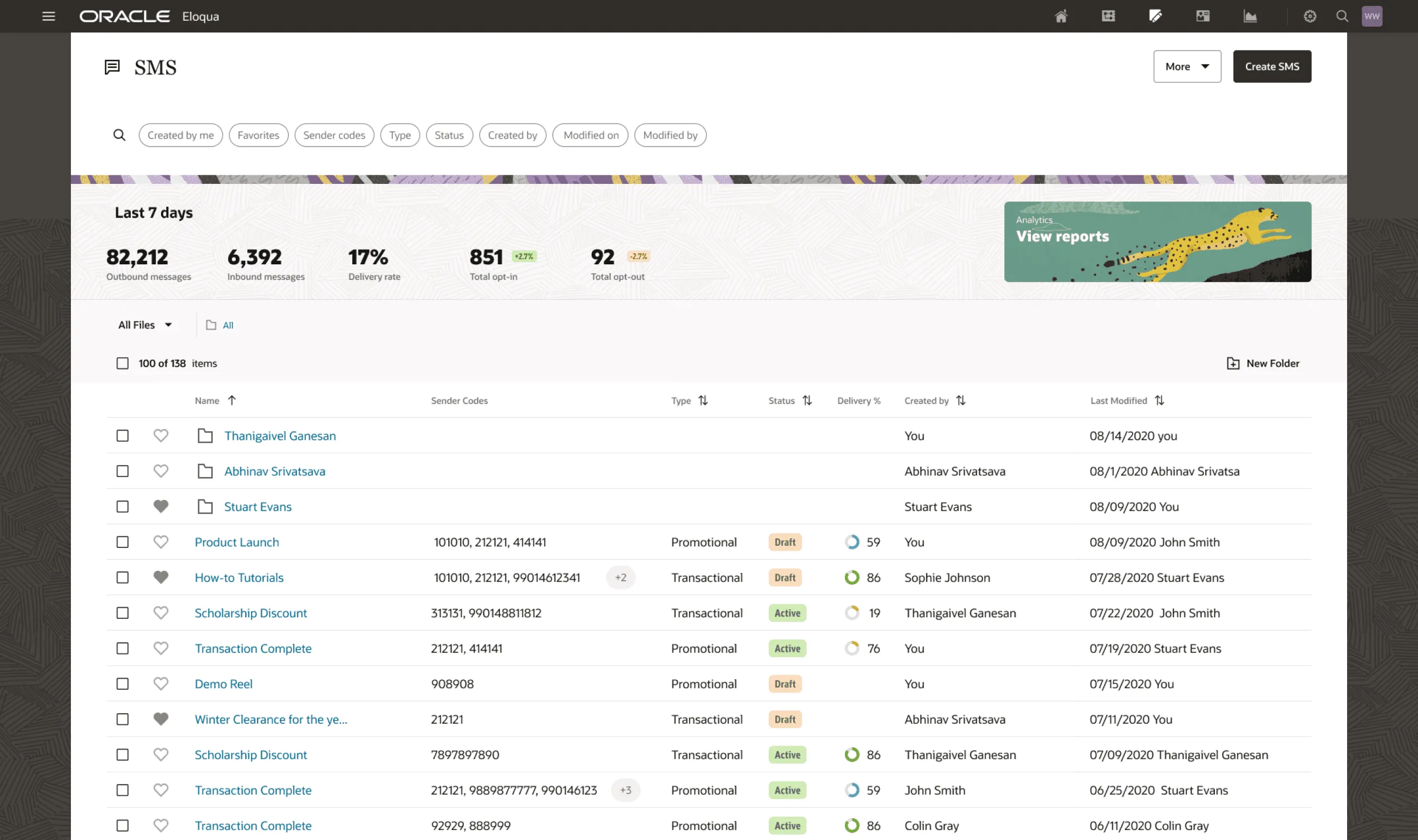
Overview
Oracle Eloqua is a cloud-based marketing automation platform that helps marketers create, manage, and automate multi-channel campaigns.
The objective of this project was to introduce native SMS capabilities within Eloqua, enabling marketers to create targeted messages and build interactive customer conversations without relying on third-party applications.
Challenges
SMS presented an opportunity for more immediate and direct customer engagement, particularly in mobile-first markets such as APAC.
However, marketers faced several limitations:
- Reliance on third-party applications for SMS capabilities.
- Additional costs and fragmented marketing workflows.
- Limited ability to create response-driven conversations.
- Difficulty visualizing customer responses and subsequent marketer actions.
Adding SMS as one more channel was the easy part. Marketers needed a way to plan a full back-and-forth with a customer.
Approach
The initial requirement was to support a simple, single-level conversation within Eloqua:
Outbound message → Customer response → Marketer response
While exploring the requirements with the product owner, I identified an opportunity to extend this model beyond single-level conversations.
Rather than designing an SMS-specific feature, I proposed a scalable conversation design framework that could support multi-level interactions, branching conversations, and different use cases across Oracle's product ecosystem.
The design approach focused on three areas:
- Simplifying the creation and management of complex conversations.
- Providing a unified view of messages, responses, and their relationships.
- Establishing a scalable interaction model that could extend beyond Eloqua.
Mapping the Conversation Flow
I mapped the end-to-end workflow to understand how marketers create outbound messages, configure customer responses, and define subsequent actions.
This helped establish the underlying conversation structure before exploring interface concepts.
Design Explorations
I tried different ways for marketers to build and manage conversations with more than one level.
Forms worked for a single message. They got hard to follow once a conversation had several replies.
So I moved to a canvas, where the marketer can see how each message connects to its replies.
One concept put message types into columns, so the marketer could move through a conversation without losing their place.
Three design concepts were explored:
Concept 1: Workflow model allowing marketers to set responses based on subscriber interactions.
Concept 2: Linear arrangement of response messages for easy scanning.
Concept 3: Column-wise organization of message types for efficient navigation.
Final Design
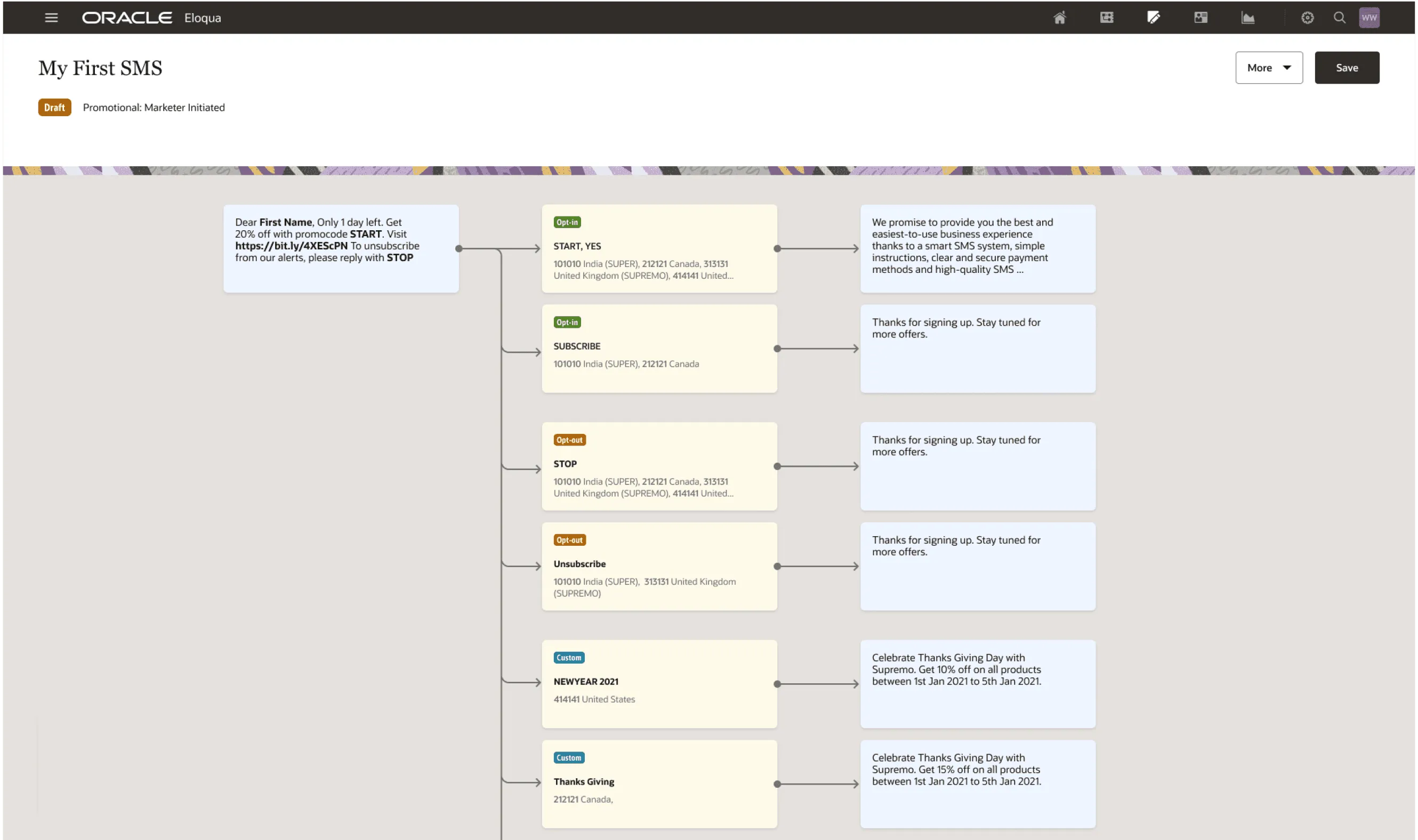
The final design introduced a unified conversation canvas built using Oracle's Redwood Design System.
Instead of creating and managing individual message assets across multiple screens, marketers could visualize and manage the entire conversation within a single workspace.
The experience enabled marketers to:
- Create and manage outbound messages.
- Configure customer responses and subsequent actions.
- Visualize branching conversations and their relationships.
- Build multi-level conversations without losing context.
- Manage the entire conversation without switching between separate message assets.
Beyond the Initial Requirement
What started as an SMS capability for Eloqua evolved into a proposal for a reusable conversation design framework.
By separating the underlying conversation model from the SMS-specific experience, the design could potentially support different communication channels, use cases, and products across Oracle.
Design Impact
The design covered what Eloqua needed and gave Oracle a base to build on. It was designed to:
- Remove the need for a separate SMS app.
- Make long conversations simple to build and manage.
- Show the whole conversation and every customer reply in one view.
- Give future features one model to build on.
- Let other Oracle products use the same canvas.
I was asked for one feature. I came back with a model Oracle could reuse.